KL Rahul’s Comeback. Forgetting his disappointing performances of the past, KL Rahul is now hungry for runs. He’s already shown glimpses of this new form in IPL 2025. After parting ways with Lucknow in a controversial manner in 2024, Rahul joined Delhi Capitals and has delivered back-to-back match-winning innings.
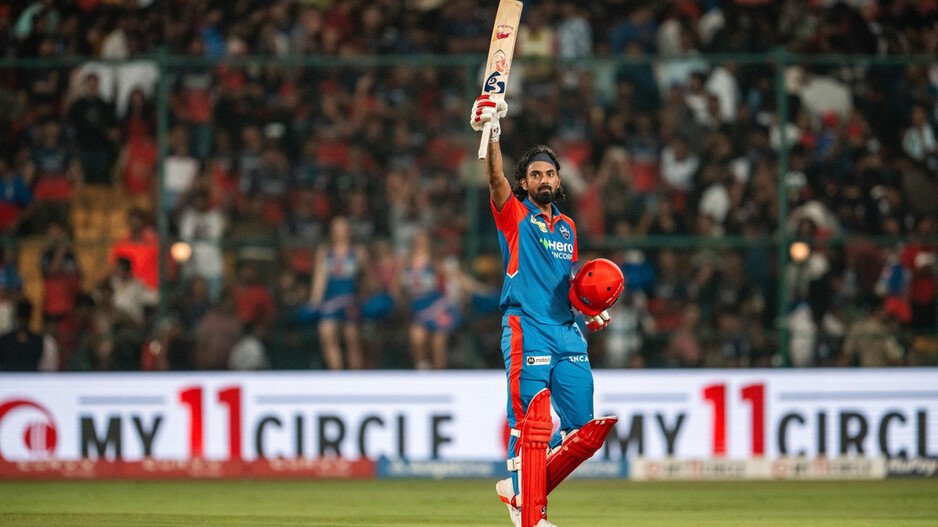
On Thursday, at his home ground M. Chinnaswamy Stadium, Rahul played an unbeaten knock of 93 runs off 53 balls, announcing his rebirth. KL Rahul 2.0 is all about explosiveness, confidence, and skill. Thanks to his innings, Delhi defeated RCB and climbed to the top of the points table.
Just like in 2014, when Rahul rose to fame with his elegant shot-making, he’s back in that rhythm. The shots that once made him a three-format player for India are now flowing again from his bat. From the beginning of his career, Rahul’s batting style earned him a spot in the Indian team. He was even considered the next big star in Indian cricket.
However, post-COVID, this Karnataka batter changed his batting style drastically. His performances looked lackluster and lacked spark. He was often criticized, and his conservative approach sometimes cost his team matches. Though he scored in the IPL, he often got out at crucial moments and struggled as a leader. At one point, there were doubts if he even had a future in the game.
But they say form is temporary, class is permanent—and Rahul has proven that over the last few months. He has undergone a significant mental shift, evident from his consistent and confident innings.
The old Rahul used to take 10 balls to settle in before trying big shots. The new Rahul 2.0 isn’t afraid to attack from ball one. After a few big shots, he assesses the pitch and adapts accordingly. His masterclass innings against RCB on Thursday showed he no longer holds back. In the very first 6 balls of the match, he struck two boundaries—proving he is playing with intent and clarity.
His unbeaten 93 off 53 balls earned him the Player of the Match award. He said after the match:
“It was a slightly tricky wicket, but after keeping for 20 overs, I could understand how it would behave. The pitch had some grip but was otherwise stable. I wanted to get off to a good start and then build the innings with an attacking mindset.”
Rahul’s innings was not just about powerful shots—it was a lesson in how to read the pitch and maximize opportunities. But this didn’t come easy. He emphasized the importance of rigorous training and adaptation.
He explained,
“During practice, I try to adjust to different kinds of wickets. If there’s turn, I focus on where to place the shots. These practice sessions help me understand where boundaries are likely. Sometimes I get out in practice, but it gives me valuable insights on how to tackle different conditions.”
In Thursday’s match, Rahul was 12 off 7 balls when Delhi had already lost 3 wickets for just 30 runs. So he started playing smart cricket—rotating strike and avoiding unnecessary risks. Luck also favored him—a tough catch was dropped by Rajat Patidar, and an edged shot off Hazlewood flew over third man for six. A mistimed cut shot also narrowly evaded the fielder. But after that, Rahul gave RCB bowlers no more chances. His shot selection was flawless and controlled.
While rotating strike, he kept finding boundaries in between. Hence, there was no need to drastically change his batting style. Playing with caution and intent, he not only built his innings but also ensured a win for Delhi.
Rahul reached his half-century in 37 balls, which included 3 sixes and 3 fours. In the middle overs, he also accelerated against Krunal Pandya and Liam Livingstone. After 14 overs, Delhi needed 65 runs from 36 balls. With light drizzle falling at M. Chinnaswamy and DLS calculations looming, Delhi was 8 runs behind the par score at that moment.
Seeing the situation, Rahul shifted gears and unleashed his explosive avatar. In the 15th over bowled by Josh Hazlewood, Rahul treated him like a club-level bowler and punished him…